The synesthetic power of sound in exhibition design: From sound as trigger to sound as interpreter
DOI:
https://doi.org/10.60923/issn.3034-9699/26203Keywords:
Exhibition Design, Museum Studies, Narration, Soundscapes, Multisensory SpacesAbstract
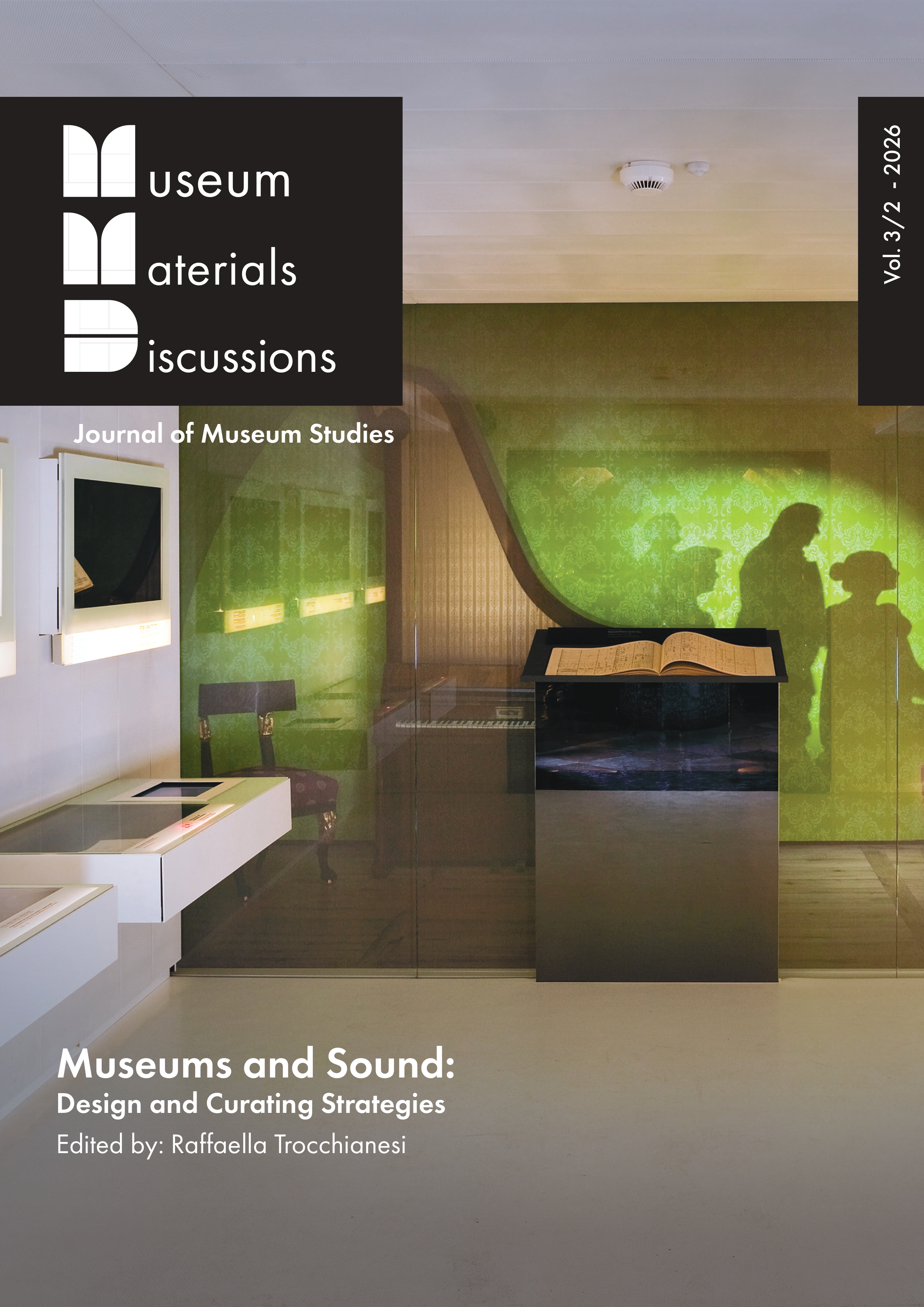
Museums and exhibitions are increasingly becoming places of narration. The design of their exhibition systems implies not only “displaying” but rather developing a “participatory planning that generates shared and sharable culture”. This proposal starts from the central premise that exhibition design must intercept and activate the perceptual capacities of our senses. Our contemporary world is increasingly inclined to an obsessive spectacularization of images; storytelling, however, is based on listening by its very nature. It is inherently auditory, even before being visual. In the sphere of exhibition design, combining sound and sight means enhancing the capacity of environments and artefacts to enter into symbiotic resonance with visitors, triggering a synaesthetic condition in which a new sense, unconsciously called into play, activates different experiential levels, involves the other senses, and generates perceptual concatenations. Specifically, through the analysis of some paradigmatic case studies, this article aims to explore what happens when sound interacts with exhibition content, bringing it to life, and to examine the curatorial approaches and the methodological and operational choices that underpin them. Here, sound acts as a catalyst or accompaniment, ultimately becoming the interpreter of the narrative, thus fulfilling the dual role of both content and narrative and participatory tool.
Downloads
Published
How to Cite
Issue
Section
License
Copyright (c) 2026 Marco Borsotti

This work is licensed under a Creative Commons Attribution 4.0 International License.